
AI Guidance Policy for Graduate Mathematics Students
Introduction
Artificial Intelligence (AI) tools, such as Large Language Models (LLMs), are powerful resources that are transforming how mathematicians construct proofs, explore concepts, organize literature, and draft documents. The Graduate Committee recognizes that fluency in these tools is becoming a professional asset. However, the core of graduate education in mathematics is the development of deep, independent cognitive abilities—specifically, the capacity for rigorous logical deduction, creative problem solving, and precise mathematical communication.
Our guiding philosophy is that AI should support, but never replace, a student's cognitive effort. Specifically:
- Exploration over Replacement: AI is an excellent sounding board for brainstorming and exploration, but the "productive struggle" of mathematics cannot be outsourced.
- Analyze and Verify: Treat any AI output like a scientist would treat raw data, that is, as the outcome of a controlled experiment that needs to be carefully studied and analyzed before you can draw conclusions from it.
- Principles for Writing: Students must learn to articulate complex mathematical ideas independently before asking an algorithm to do it for them. You must generate your own first draft before using AI for feedback, editing, or structural suggestions. Furthermore, for any changes or additions that AI makes, you must understand that content, and you must rewrite it yourself. Articles, theses, etc should not use AI-generated text.
- Accountability: You are strictly responsible for the mathematical accuracy, originality, and rigor of any work you submit, regardless of the tools used in its preparation.
We also note that these are recommendations only, and do not replace any departmental or university policy as outlined in the graduate handbook or course syllabus. We also encourage you to have regular conversations with your advisor about their expectations and advice regarding AI use.
Guidelines by Graduate Stage
The appropriate use of AI shifts as students progress from foundational coursework to independent, original research. Below are specific guidelines for each stage of the graduate program. Again, although AI is a useful tool for exploring and learning mathematics, students must develop the ability to independently judge the mathematical correctness of statements and must also develop the ability to generate their own original research ideas.
Stage 1: First-Year Coursework & Qualifying Exams
In the first year, the primary goal is to master fundamental concepts and develop the "mathematical maturity" required to construct complex proofs. AI should be used minimally at this stage, strictly as a supplementary tutor, not as a shortcut to bypass homework or fundamental learning. Care should be taken not to use AI as a replacement for important discussion taking place with your cohort, senior graduate students, and your professor in office hours. In-person discussions remain the best way to learn and test your ideas. Furthermore, one shouldn’t rely on AI to check the validity of your proofs; you should develop and trust your own logical verification.
| ✅ Recommended | ❌ Not Recommended |
|---|---|
|
|
Stage 2: Preparing for Oral Exams
During this stage, students are synthesizing broad areas of mathematics, organizing extensive reading lists, and preparing to verbally articulate deep connections. AI can be effective here as an organizational and exploratory tool, though it may not always meet a student where they are. Care should be taken that students learn the essential skill of reading a research article and understanding its key arguments without relying on AI-summaries. This is not an easy skill to acquire, but it is even more essential as AI increases mathematical output.
| ✅ Recommended | ❌ Not Recommended |
|---|---|
|
|
Stage 3: Research and Dissertation Writing
In the final stage, students are producing novel mathematical knowledge. We have divided this stage into two critical areas: the research/exploratory phase and the writing/composition phase. Writing is a massive component of the work and a primary tool for understanding; the better you understand something, the better you can explain it. You cannot verify that your work is correct without the hard work of writing rigorous proofs, a skill students must learn through the task of writing a dissertation. We also recommend that students regularly touch base with their advisors on their own AI usage, as well as how AI is being used in the industry.
Part A: Research, Exploration, and Experimentation
AI can be an incredibly useful tool for the exploratory phase of mathematical research, serving as a tireless computational and organizational assistant.
| ✅ Recommended | ❌ Not Recommended |
|---|---|
|
|
Part B: Dissertation and Manuscript Writing
When translating research into formal academic papers, the "Draft-First" principle is paramount. The Graduate committee overwhelmingly agrees. Writing is also about understanding; the better you understand something, the better you can explain it. Also, you can’t verify that your work is correct without the hard work of writing rigorous proofs. Students must learn this through the hard task of writing a dissertation.
| ✅ Recommended | ❌ Not Recommended |
|---|---|
|
|
We expect every thesis to be written by the student, without any AI-generated text.
Enforcement and Transparency
If you are unsure whether a specific use of AI falls is acceptable, consult with your advisor or the graduate committee before proceeding. Transparency is key. When preparing publications or your final dissertation, follow standard academic practices for acknowledging the use of AI tools in data processing, coding, or heavy editing, in alignment with the target journal's specific policies.
Evolving Landscape
The rapid evolution of AI models is resulting in rapid and dramatic changes to mathematics and mathematical research. People at every career stage are working to figure out how to incorporate these new tools into their research in ethical and effective ways. As with all technological advances, it is a double-edged sword; the graduate committee feels that the largest pitfall is “cognitive surrender.” This can happen to both junior and senior mathematicians, and involves replacing original thought with overreliance on and blind trust in LLM models. We hope the guidelines described here will help prevent all of us from falling into this trap!
We will update this document as tools continue to evolve. It is important we have open and frank discussions with each other about all aspects of AI; in keeping with this, the graduate committee welcomes all comments and suggestions.
Contact Information
Tel (713) 348-4829
Mailing Address:
Rice University
Math Department -- MS 136
P.O. Box 1892
Houston, TX 77005-1892
Physical Address:
Rice University
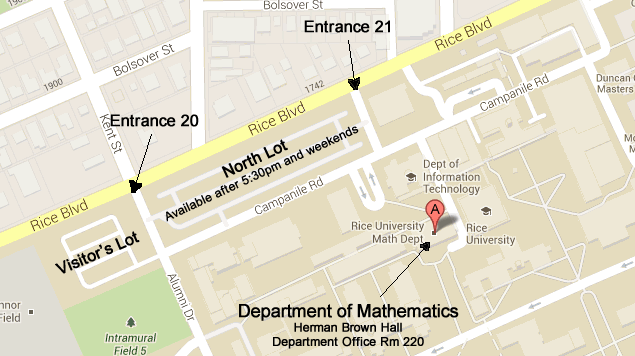
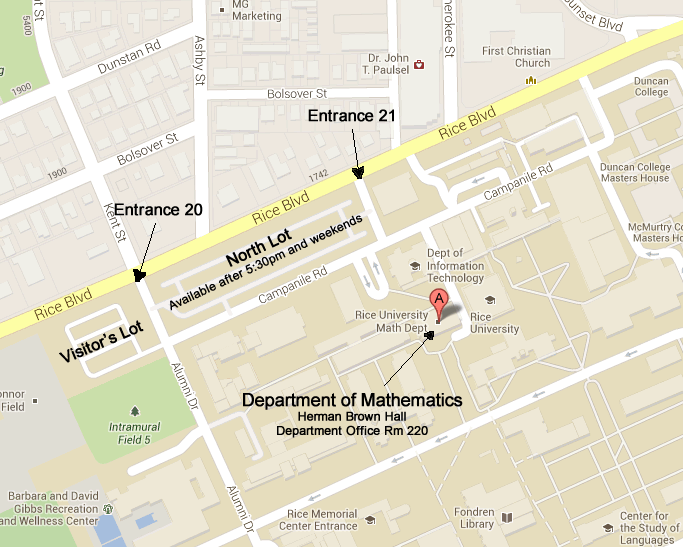
Herman Brown Hall for Mathematical Sciences
6100 Main Street
Houston, TX 77005