
2026 Ph.D Thesis Defenses
Alexandre Maldague
Title: Superrigidity of Rich Representations
Thesis Advisor: David Fisher
The main results of this thesis concern the class of geodesically rich representations. These are representations of (real or complex) hyperbolic lattices that preserve a significant amount of the geometric structure of the associated quotient manifold. When the quotient manifold has robust geometric structure, these representations exhibit rigidity phenomena. In particular, a recent superrigidity theorem for rich representations was used to prove that finite-volume hyperbolic manifolds with infinitely many maximal totally geodesic submanifolds are arithmetic (Bader-Fisher-Miller-Stover).
In this thesis, we obtain a new superrigidity theorem for rich representations that efficiently recovers existing results and addresses target groups that were previously inaccessible. The proof requires developing a new boundary-theoretic framework for studying superrigidity, built essentially upon the notion of algebraic representations of ergodic actions (AREA) developed by Bader and Furman. As an application, we introduce a new geometric constraint on the deformations of arithmetic hyperbolic lattices. Finally, our results lead us to conjecture a general superrigidity theorem for rich representations.
Miri Son
Title: Classification of SL(n,R)-actions on closed manifolds
Thesis Advisor: David Fisher
We classify real-analytic SL(n,R)-actions on closed m-dimensional manifolds where 3 ≤ n ≤ m ≤ 2n − 3. Our results show that every such action arises from a geometric construction associated with maximal parabolic subgroups. More precisely, these actions are realized as suspension spaces of certain flows on invariant submanifolds. This generalizes the work of Fisher-Melnick on SL(n,R)-actions on closed n-manifolds. In addition, we classify smooth SL(n,R)-actions on closed m-manifolds that have no global fixed points. This work is motivated by the Zimmer program which studies rigidity phenomena for actions of higher-rank Lie groups and their lattices.
This classification relies on the orbit classification describing all possible orbit types of SL(n,R)-actions on manifolds. When actions have global fixed points, we also use the linearization results of Guillemin-Sternberg and Kushinirenko for real-analytic SL(n,R)-actions.
As a corollary, we study the density or non-density of structurally stable smooth fixed-point free SL(n, R)-actions using classical results on density of structural stability by Peixoto, Williams, and Newhouse. We show that the density of structural stable actions depends on the dimension of the invariant submanifold that determines the action.
Olivia Del Guercio
Title: On teh Classification of Cyclic and Quasi-Cyclic Albebraic Geometry Codes over Projective N-Space
Thesis Advisor: Anthony Varily-Alvarado
Cyclic and quasi-cyclic codes are widely used in engineering applications for their efficient encoding and decoding capabilities. We see cyclic codes in action when NASA interprets data from the Voyager Space Probe that has been corrupted in transmission or when our phones decipher a partially obscured QR code. Although the discipline of coding theory was introduced by Shannon in the late 1940s, it was not until 1982 that Tsfasman et. al. were able to exhibit the first family of codes to beat the Gilbert-Varshamov possibility result using algebraic geometry (AG) codes. AG codes are derived from evaluating rational functions on points on varieties over finite fields. Leveraging the efficacy of AG codes with the utility of cyclic codes is naturally a compelling combination. In 2022, Cabaña et al. discovered a novel approach to constructing cyclic AG codes using the underlying curve’s automorphism group known as the sigma method. Given a new set of mathematical objects, it is natural to classify them. Cabaña et al. also demonstrated that for a given length and dimension, all one-point divisor rational sigma-cyclic codes over the projective line are monomially equivalent. Utilizing a new, geometric, scheme-theoretic method, the main result of this thesis generalizes this finding to projective N-space. This generalization opens up new potential applications to code-based cryptography.
Camilo Arosemena Serrato
Title: Global Rigidity of Codimension One Actions
Thesis Advisor: David Fisher
The classification of actions of lattices of large classes of higher rank simple Lie groups on manifolds of low dimension, with respect to the Lie group, or when such actions have certain regularity properties, represents major recent advances in the Zimmer program. This has been established in the work of Brown, Fisher, and Hurtado, as well as Brown, Rodriguez-Hertz, and Wang. An important corresponding goal in this program is classifying smooth actions of the higher rank simple Lie groups themselves on manifolds, under dimensional or regularity assumptions. In this thesis, we give a global rigidity result lying at the intersection of this problem with the study of codimension one foliations. Specifically, we prove that for a large class of higher rank simple Lie groups (e.g., SL(n,R) for n > 3; SO(n,n) for n >2; Sp(2n,R) for n > 1, etc.), any closed manifold admitting a locally free action of such a group G must be a fiber bundle with base space G/H, where H is either a lattice or a parabolic subgroup of G. In fact, it must be the induced bundle of an action of H on a closed manifold. This provides the first major classification of locally free actions of such groups in the first nontrivial dimension, without any geometric or dynamical assumption. The argument relies on showing that stable manifolds depend smoothly on points for which a priori such dependence is only measurable, along with a geometric version of the high entropy method of Einsiedler and Katok.
Hyein Choi
Title: Quasi-isometric embeddings of Ramanujan complexes
Thesis Advisor: David Fisher
Ramanujan complexes were defined as high dimensional analogues of the optimal expanders, Ramanujan graphs. They were constructed as quotients of the Euclidean building (also called the affine building and the Bruhat-Tits building) of PGL_d(F_p((y))) for any prime p by Lubotzky-Samuels-Vishne. We distinguish the Ramanujan complexes up to large-scale geometry. More precisely, we show that if p and q are distinct primes, then the associated Ramanujan complexes do not quasi-isometrically embed into one another. The main tools are the box space rigidity of Khukhro-Valette and the Euclidean building rigidity of Kleiner-Leeb and Fisher-Whyte.
Fernando Liu Lopez
Title: Twisting Systems in Closed Monoidal Categories
Thesis Advisor: Chelsea Walton
Zhang twists are a tool for “deforming” the product of graded k-algebras while preserving desirable ring-theoretic properties. As the study of algebras in monoidal categories beyond Veck grows in popularity, it has become increasingly important to find ways of twisting algebras in monoidal categories. To this end, this thesis generalizes Zhang twists to the setting of closed monoidal categories equipped with a canonical enriched structure. Along the way, we also prove several results concerning closed monoidal categories and algebraic structures within them. We use these results to provide necessary and sufficient conditions for when graded algebras connected by Zhang twists produce equivalent categories of graded modules.
Junmo Ryang
Title: Pseudo-Anosov subgroups of surface-by-abelian extensions
Thesis Advisor: Christophe Leininger
In 2002, Farb and Mosher introduced convex cocompact subgroups of mapping class groups to capture the coarse geometry of their associated surface bundles. The success of their theory indicates that convex cocompact subgroups are key objects in the study of Gromov hyperbolic surface bundles. Despite this, some of the earliest questions asked of these groups remain open even after decades. Convex cocompact subgroups are necessarily finitely generated and purely pseudo-Anosov, but it is still unknown whether the converse is true. Several partial results are known in certain settings, however. For example, work of Dowdall, Kent, Leininger, Russell, and Schleimer give a positive answer for subgroups of fibered 3-manifold groups (or surface-by-cyclic extensions) naturally embedded in punctured mapping class groups via the Birman exact sequence. In this thesis, we present a generalization of these results to the setting of surface-by-abelian extensions.
Contact Information
Tel (713) 348-4829
Mailing Address:
Rice University
Math Department -- MS 136
P.O. Box 1892
Houston, TX 77005-1892
Physical Address:
Rice University
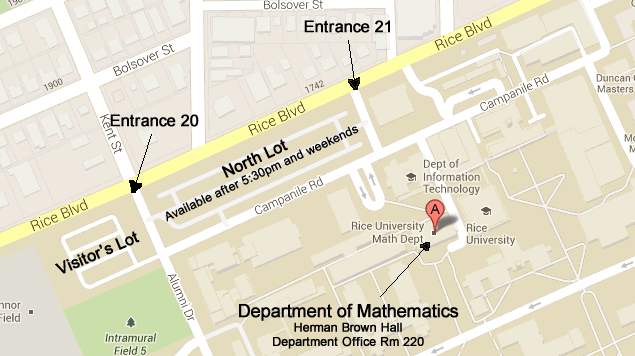
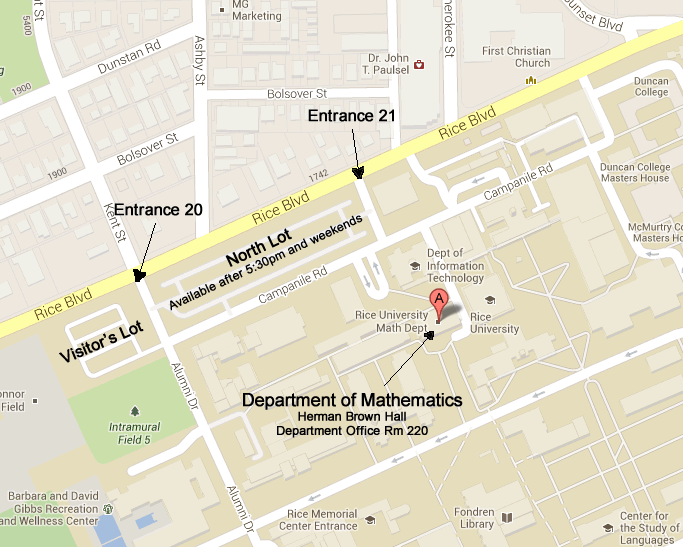
Herman Brown Hall for Mathematical Sciences
6100 Main Street
Houston, TX 77005