
2024 Ph.D Thesis Defenses
Alex Manchester
Title: Satellite constructions and topological concordance Satellite constructions and topological concordance
Thesis Advisor: Shelly Harvey
In [CFT07], Cochran-Friedl-Teicher unified and generalized many existing constructions of topologically slice links using the language of satellite constructions. Many such links have been shown to not be smoothly slice, and links which are topologically but not smoothly slice are some of the most fundamental examples of exotic behavior in 4-dimensional topology. In this thesis, we will give an improvement on the Milnor’s µ¯-invariant condition that appears [CFT07], which will allow us to give some examples of topologically slice links which are not covered by [CFT07]. We will then move on to prove an approximate relativization of this theorem, and then show that a wide class of metabelian invariants, in particular Casson-Gordon invariants and metabelian ρ-invarinats, do not obstruct the honest relativization from holding. If the honest relativization did hold, it would give strong evidence that knots with homology cobordant 0-surgeries are topologically concordant, which is known to be false smooothly (see [CFHH13] and [Col22]). We will also discuss how topological concordance can be interpreted for links in homology spheres other than S3. While moving to the more general setting of homology spheres does produce new knots and links up to concordance smoothly (see [Don83] and [Lev16]), there is some evidence (see [Dav20a] and [Dav23]) that every knot in a homology sphere is topologically concordant to a knot in S3. We will record the fundamental fact that there is a canonical homology cobordism between any two homology spheres characterized by its simple connectedness, which gives a concrete place to look for concordances.
Jiayu Wan
Title: On Azumaya algebras associated to certain 2-bridge links
Thesis Advisor: Alan Reid
Let \Gamma be a finitely generated group and consider the set of all characters of representations of \Gamma into SL_2(\mathbb{C}). This set, denoted by X(\Gamma), admits an algebraic structure and is called the character variety of \Gamma. When \Gamma is the fundamental group of a hyperbolic 3-manifold M, X(\Gamma) turns out to be a powerful tool in the study of the geometry and topology of M. Chinburg-Reid-Stover have borrowed tools from algebraic and arithmetic geometry to understand algebraic and number-theoretic properties of certain components, which are called the canonical components, of X(\Gamma) (in our case, the component is going to an algebraic surface). In particular, they have built a canonically defined quaternion algebra A_{k(C)} over the function field of a canonical component of X(\Gamma) and studied certain properties related to this quaternion algebra. In this thesis, we are going to partly generalize their results. To be specific, we are going to prove that when \Gamma is the fundamental group of certain hyperbolic link complements, the canonical quaternion algebra won’t extend to an Azumaya algebra over the whole surface.
Zac Spaulding
Title: From infinite to finite: rational reductions of del pezzo surfaces
Thesis Advisor: Anthony Varilly-Alvarado
It is well-known that all del Pezzo surfaces of degree at least 5 over a finite field are rational, i.e., birational to the projective plane, but this is generally not true for those of lower degree. If we fix a del Pezzo surface X of degree d < 5, defined over a number field k, and consider the primes p of k of good reduction for X, then we may ask: how often do we expect X_p, the reduction of X modulo p, to be rational?
To answer this question, we combine a result of Colliot-Thélène from 2019 with the Chebotarev Density Theorem to determine the natural density of the set \pi_{rat}(X,k) --- the set of primes of k for which the reduction X_p is F_p-rational --- in the set of all primes of k. We present an algorithm to determine this natural density with input data being the action of the absolute Galois group of k on the geometric Picard group. We implement this algorithm in magma, exhibiting the nonzero uniform lower bound 1/1920 for this natural density, independent of starting data.
Sara Edelman-Munoz
Title: This surface subgroups of non-uniform, arithmetic lattices in SO+ (𝓃,1)
Thesis Advisor: Alan Reid
In this thesis I show that the
Parker Evans
Title: Geometry of G′₂ - harmonic maps and representations
Thesis Advisor: Mike Wolf
We discuss two geometric problems related to the Lie group G₂′ , the split real (adjoint) form of the exceptional complex Lie group G₂𝕔. First, we consider a family of alternating almost-complex curves νˆ : ℂ⎮ → Sˆ2,4 in the almost-complex pseudosphere Sˆ2,4 ⊂ R3,4, with each curve νˆ ≔ νˆq associated to a holomorphic sextic polynomial q ∶ ℂ → ℂ. We show that, in an appropriate sense, the asymptotic boundary ∆ ≔ ∂∞νˆq is a polygon with (deg q + 6) vertices in Ein2,3, the frontier of PSˆ2,4 inside of PR3,4. These boundaries are shown to have the annihilator property. We then give a (G, X)-structures interpretation of the G’₂ -Hitchin component Hit(S, G₂′) of a closed oriented surface S of genus 𝔤 ≥ 2. In particular, we prove that Hit(S, G′₂ ) is naturally homeomorphic to the moduli space of cyclic, compatible, radial (G₂′ , Ein2,3)-structures on the direct sum of fiber bundles UTS⊕UTS⊕R+, where UTS denotes the unit tangent bundle. The geometric structure associated to [ρ] ∈ Hit(S, G₂′ ) is directly built from the unique ρ-equivariant alternating almost-complex curve νˆ ∶ S˜ → Sˆ2,4
Xingya Wang
Title: Spectral analysis of Schrodinger operators with decaying distributional potentials
Thesis Advisor: Milivoje Lukic
The primary theme of this thesis is to extend various classical techniques and spectral results regarding 1-dimensional Schr¨odinger operators with locally integrable potentials to the more general setting of distributional potentials which are locally in the Sobolev space H−1. We will start by reviewing the classical spectral theoretical framework along with relevant results obtained therein. Next, we proceed to establish the corresponding framework in the distributional setting, and recover Last–Simon- type description of the absolutely continuous spectrum and sufficient conditions for different spectral types. In the last chapter, we focus on potentials which are decaying in a locally H−1 sense. In particular, we prove a spectral transition between short- range and long-range in the class of sparse distributional potentials, and we establish WKB-type asymptotic behavior of eigenfunctions and spectral properties for locally H−1 potentials whose decay rate is between L1 and L2.
Contact Information
Tel (713) 348-4829
Mailing Address:
Rice University
Math Department -- MS 136
P.O. Box 1892
Houston, TX 77005-1892
Physical Address:
Rice University
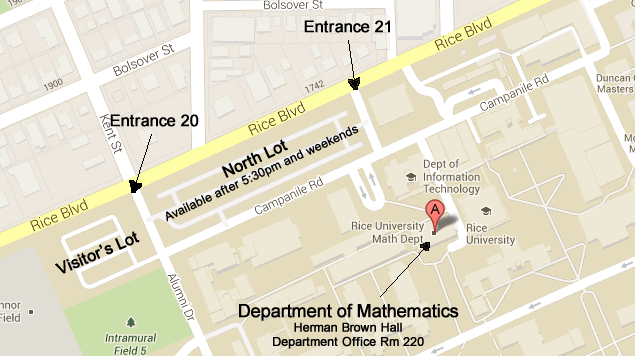
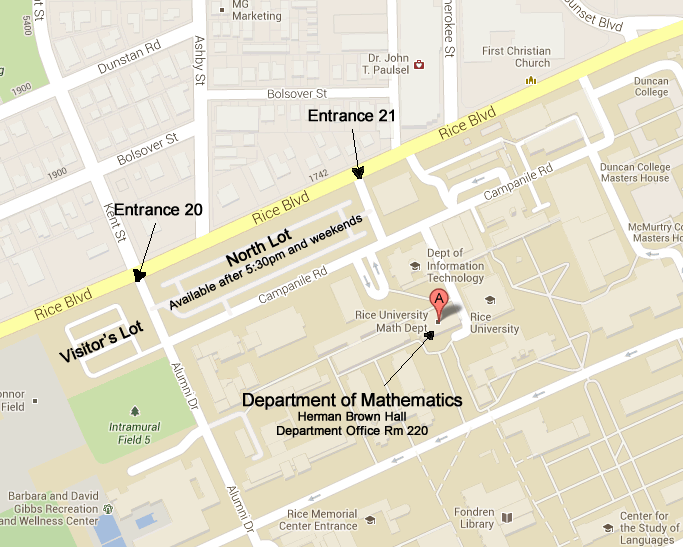
Herman Brown Hall for Mathematical Sciences
6100 Main Street
Houston, TX 77005