
2023 Ph.D Thesis Defenses
Tam Cheetham-West
Title: Finite Quotients of Hyperbolic 3-Manifold Groups
Thesis Advisor: Alan Reid
This thesis provides further evidence of the seemingly very close relationship be-tween the geometry of a finite-volume hyperbolic 3-manifold and the profinite completion of its fundamental group.
Ethen Gwaltney
Title: Stahl-Totik regularity and exotic spectra of Dirac operators
Thesis Advisor: Milivoje Lukic
This thesis motivates and presents three novel results in the spectral theory of one-dimensional Dirac operators, each of which concerns various forms of exotic or distinguished spectral characteristics. First, we consider the possibility of embedded eigenvalues in the absolutely continuous spectrum of a Dirac operator with operator data of Wigner-von Neumann type. Second, we demonstrate the genericity of Cantor spectrum when the operator data is chosen to be limit-periodic. Third, we provide for the Dirac operator setting an analogue of Stahl-Totik regularity, which, among other things, provides a lower bound on the thickness of the spectrum in terms of the operator data when the data is taken to be uniformly locally square integrable.
Connor Sell
Title: Cusps and commensurability classes of hyperbolic 4-manifolds
Thesis Advisor: Alan Reid
It is well-known that the cusp cross-sections of finite-volume, cusped hyperbolic n-manifolds are flat, compact (n − 1)-manifolds. In 2002, Long and Reid proved that each of the finitely many homeomorphism classes of flat, compact (n − 1)-manifolds occur as the cusp cross-section of some arithmetic hyperbolic n-orbifold; the orbifold was upgraded to a manifold by McReynolds
in 2004. There are six orientable, compact, flat 3-manifolds that can occur as cusp cross-sections of hyperbolic 4-manifolds. This thesis provides criteria for exactly when a given commensurability class of arithmetic hyperbolic 4-manifolds contains a representative with a given cusp type. In particular, for three of the six cusp types, we provide infinitely many examples of commensurability classes that contain no manifolds with cusps of the given type; no such examples were previously known for any cusp type in any dimension. Further, we extend this result to find commensurability classes of hyperbolic 5-manifolds that avoid some compact, flat 4-manifolds as cusp cross-sections, and classes of non-arithmetic manifolds in both dimensions that avoid some cusp types
Asgeir Valfells
Title: Local Criteria in Polyhedral Minimizing Problems
Thesis Advisor: Bob Hardt
This thesis will discuss two polyhedral minimizing problems and the necessary local criteria we find any such minimizers must have. We will also briefly discuss an extension of a third minimizing problem to higher dimension. The first result we present classifies the three-dimensional piecewise linear cones in R4 that are mass minimizing w.r.t. Lipschitz maps in the sense of Almgren’s M (0, δ) sets as in Taylor’s classification of two-dimensional soap film singularities. There are three that arise naturally by taking products of R with lower dimensional cases and earlier literature has demonstrated the existence of two with 0-dimensional singularities. We classify all possible candidates and demonstrate that there are no p.l. minimizers outside these five. The second result we present is an assortment of criteria for edge-length minimizing polyhedrons. The aim is to get closer to answering a 1957 conjecture by Zdzislaw Melzak, that the unit volume polyhedron with least edge length was a triangular right prism, with edge length 22/3311/6 ≈ 11.896. We present a variety of variational arguments to restrict the class of minimizing candidates.
Chunyi Wang
Title: Direct and Inverse Spectral Theory for the Hamiltonian System with Measure Coefficients
Thesis Advisor: David Damanik
This thesis discusses the direct and inverse spectral theory of Hamiltonian systems with measure coefficients, which can cover more singular cases. In the first part, we define self-adjoint relations associated with the systems and develop Weyl-Titchmarsh theory for these relations. Then, we develop subordinacy theory for the relations and discuss several cases when the absolutely continuous spectrum appears. Finally, we develop inverse uniqueness results for Hamiltonian systems with measure coefficients by applying de Branges’ subspace ordering theorem. Overall, this thesis contributes to the study of Hamiltonian systems with measure coefficients, expands the self-adjoint operator theory to a more general class of physical models, and investigates common spectral properties among different model
Harshit Yadav
Title: Functorial constructions of Frobenius algebras in the Drinfeld center
Thesis Advisor: Chelsea Walton
Frobenius algebras in vector spaces are classical algebraic structures. However, because of their discovered connections to various fields, including computer science and
topological quantum field theories, there is a growing interest in exploring their generalizations within the framework of monoidal categories. Inspired by these connections, this thesis delves into the problem of functorially constructing ‘nice’ Frobenius algebra objects in such categories. We introduce unimodular module categories and employ them to provide a functorial construction of Frobenius algebras in the Drinfeld center of a finite tensor category. We also classify unimodular module categories over the category of representations of a finite dimensional Hopf algebra
Kenneth Zheng
Title: Brauer groups of a family of nonnegative Kodaira dimension elliptic surfaces
Thesis Advisor: Anthony Varilly-Alvarado
We explore the Brauer groups of the elliptic surfaces given by y2 = x3 + t6m + 1 over Q for m = 2, 3. When m = 2, the resulting surface is K3, and when m = 3, the surface is honestly elliptic with Kodaira dimension 1. We compute the algebraic Brauer groups of these surfaces by studying the action of Gal(Q/Q) on their Neron-Severi groups. Following the work of Gvirtz, Loughran, and Nakahara [GLN22], we find bounds for the exponents of transcendental Brauer groups of these surfaces. The transcendental Brauer group is closely related to the transcendental lattice. The argument begins with an explicit description of the basis of the respective transcendental lattices and reinterpreting elements of these lattices as elements in rings of integers. From this, we bound the transcendental Brauer group. These bounds apply more generally to the surfaces given by y2 = x3 + A1t6m + A2 for Ai ∈ Z and m = 2, 3
Contact Information
Tel (713) 348-4829
Mailing Address:
Rice University
Math Department -- MS 136
P.O. Box 1892
Houston, TX 77005-1892
Physical Address:
Rice University
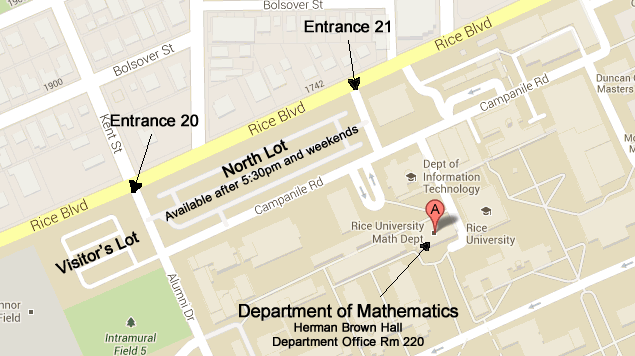
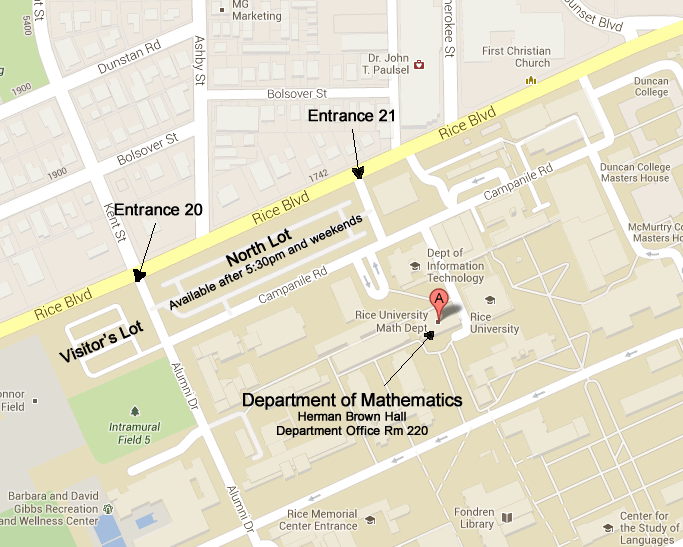
Herman Brown Hall for Mathematical Sciences
6100 Main Street
Houston, TX 77005